
Your product may be technical. Your customer isn’t.
Technology has a habit of making marketing complicated.
Features.
APIs.
Integrations.
Infrastructure.
Security.
Pricing tiers.
Product releases.
Roadmaps.
And now AI too.
All important.
But none of them matter if a real person doesn’t understand why they should care.
Marketing for technology and SaaS lives in the gap between what the product can do and what the customer actually wants to achieve.
We work in that gap.

The Technology and SaaS Paradox
The more sophisticated the product becomes, the easier it is to market the product instead of the outcome.
A new feature becomes a campaign.
A product release becomes content.
A technical capability becomes a value proposition.
And suddenly the marketing team is explaining the product instead of creating demand for it.
That’s backwards.
People don’t buy technology because of what it is. They buy what it lets them do.
From Product to Demand
Technology businesses have an unusually measurable marketing system.
Awareness.
Acquisition.
Activation.
Conversion.
Retention.
Expansion.
Advocacy.
Every stage produces signals.
Every signal can inform the next decision.
But measurement doesn’t automatically create understanding.
You can know your CAC to the cent and still not know why people aren’t buying.
You can optimise conversion and still attract the wrong customers.
You can reduce churn and still have no idea what makes the product valuable.
The data tells you what happened. Strategy tells you what to do about it.

What we look at
THE PRODUCT
We get under the hood.
Product architecture. Features. Use cases. Integrations. Differentiators. Onboarding. Pricing. Packaging.
Not to become product managers.
To understand what the product actually makes possible and translate that into something a customer can recognise as valuable.
THE JOB TO BE DONE
What is the customer actually hiring the product to do?
Save time.
Make money.
Reduce risk.
Remove friction.
Create convenience.
Improve performance.
Unlock something they couldn’t do before.
The technology is the mechanism.
The job is the reason.
THE FUNNEL
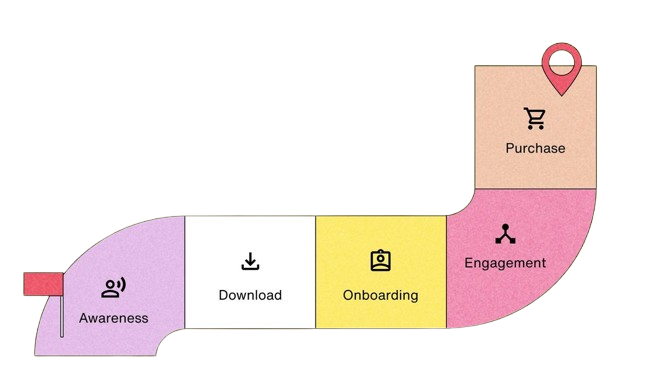
For SaaS, the funnel isn’t just awareness → purchase.
It’s a system:
Acquisition → Activation → Conversion → Retention → Expansion
Each stage has a different problem.
And each problem requires a different intervention.
More traffic won’t fix poor activation.
More leads won’t fix weak product-market fit.
More discounts won’t fix churn.
Growth starts by finding the constraint.
THE ECONOMICS
We look at the numbers that actually matter.
CAC.
LTV.
ARPU.
Conversion rate.
Payback period.
Retention.
Churn.
Expansion revenue.
Gross margin.
Then we connect them to marketing decisions.
Because growth that cannot survive the unit economics isn’t growth.
THE CULTURE
Technology doesn’t exist outside culture.
AI changes behaviour.
Platforms change expectations.
Communities shape adoption.
Creators accelerate discovery.
New technology creates new norms.
We look at the cultural context around the product — because adoption isn’t purely rational.
People don’t just adopt technology. They adopt new ways of doing things.

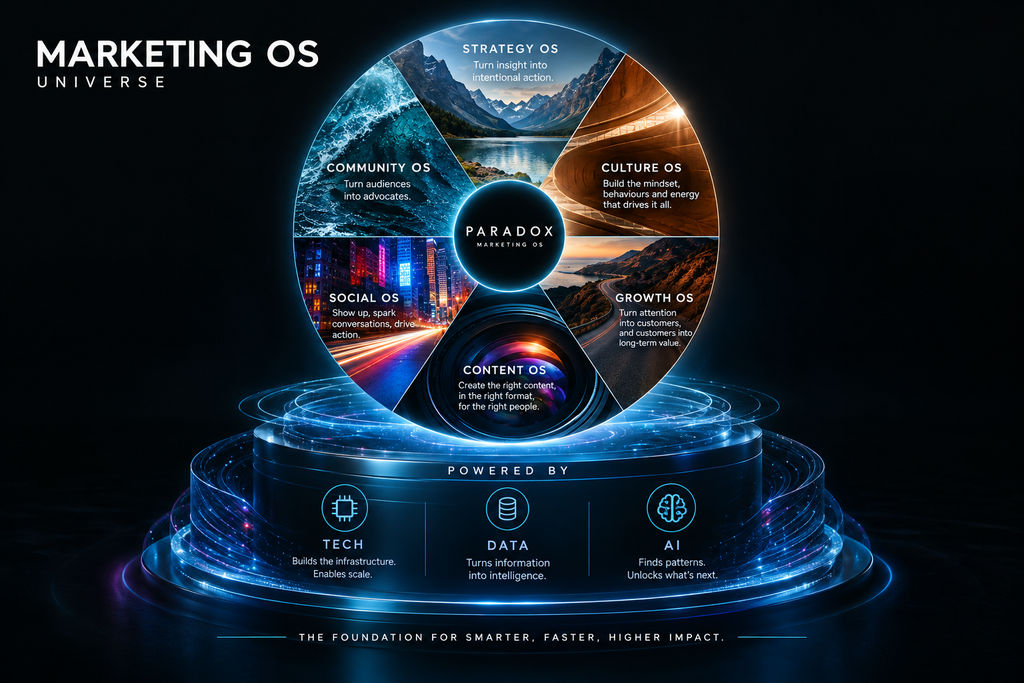
One Marketing OS. Connected to your product.
STRATEGY OS
Define the growth problem.
Positioning. Messaging. Market opportunity. Audience. Pricing and packaging. Acquisition strategy. Retention strategy.
Start with the constraint, not the channel.
CULTURE OS
Make technology mean something.
Translate technical capability into a cultural and human role.
Find the conversations, behaviours and communities that can make the product relevant beyond its feature set.
GROWTH OS
Build the growth engine.
Acquisition. Conversion. Activation. Retention. CRM. Experimentation. Lifecycle marketing.
Connect the funnel rather than optimising isolated stages.
CONTENT OS
Turn complexity into clarity.
Product education. Thought leadership. Demonstrations. Use cases. Customer stories. Social-native content.
Make the complicated understandable without making it simplistic.
SOCIAL OS
Earn attention where technology culture actually happens.
Different platforms produce different behaviours.
We build platform-specific systems rather than cross-posting the same product message everywhere.
COMMUNITY OS
Build the network around the product.
Users. Creators. Advocates. Developers. Enthusiasts. Customers.
Community can become an acquisition channel, retention mechanism, feedback loop and source of product insight.
Not an audience list. An ecosystem that participates.
Technical enough to understand. Human enough to matter.
We’re comfortable talking about CAC.
But we also want to know what the customer was trying to accomplish.
We’re interested in conversion rates.
But we also want to know what made someone hesitate.
We care about attribution.
But we also care about the situation that created the demand in the first place.
We can work with product, growth, data and technology teams without turning marketing into a spreadsheet.
Because the best technology marketing translates complexity into desire.
Built for the product, not trapped by it.
Your product team knows what the technology can do.
Your sales team knows what customers ask for.
Your data knows what people actually do.
Your marketing needs to connect the three.
That’s where the Marketing OS earns its keep.
Strategy.
Product understanding.
Culture.
Content.
Growth.
Social.
Community.
Data.
Experimentation.
One integrated system. One specialist team. One commercial direction.
The Technology and SaaS question
Everyone can explain what the product does.
The harder question is:
Why should anyone care?
Because the technology itself is rarely the story.
The story is what becomes possible because it exists.
Make the complex useful. Make the useful desirable. Make the desirable grow.
That’s Technology & SaaS, the PARADOX way.
You run the business. We run the marketing.