
Marketing shouldn’t be a collection of disconnected activities.
Strategy in one place. Creative somewhere else. Media with another supplier. Social running on its own. Data sitting in a dashboard nobody uses.
That is not a marketing system. It is a collection of activities.
PARADOX Marketing OS brings the core capabilities of a modern marketing department into one connected system.
One operating system. One team. One accountable partner.

Marketing is more connected than the way most companies run it.
Most businesses don’t have a marketing problem because they lack activity.
They have a marketing problem because too much of it happens in isolation.
Fragmented teams
Different people own different parts of marketing, often with no single point of accountability.
Multiple suppliers
Strategy, creative, media, social, production and technology are spread across agencies and freelancers.
Disconnected strategy, creative and performance
The strategy says one thing. The creative says another. Performance optimises for something else.
Too much activity
More campaigns. More content. More meetings. More reporting.
But more activity does not necessarily mean more progress.
Not enough ownership
When everyone owns a piece of marketing, nobody owns the whole thing.
PARADOX is built to solve the connection problem.
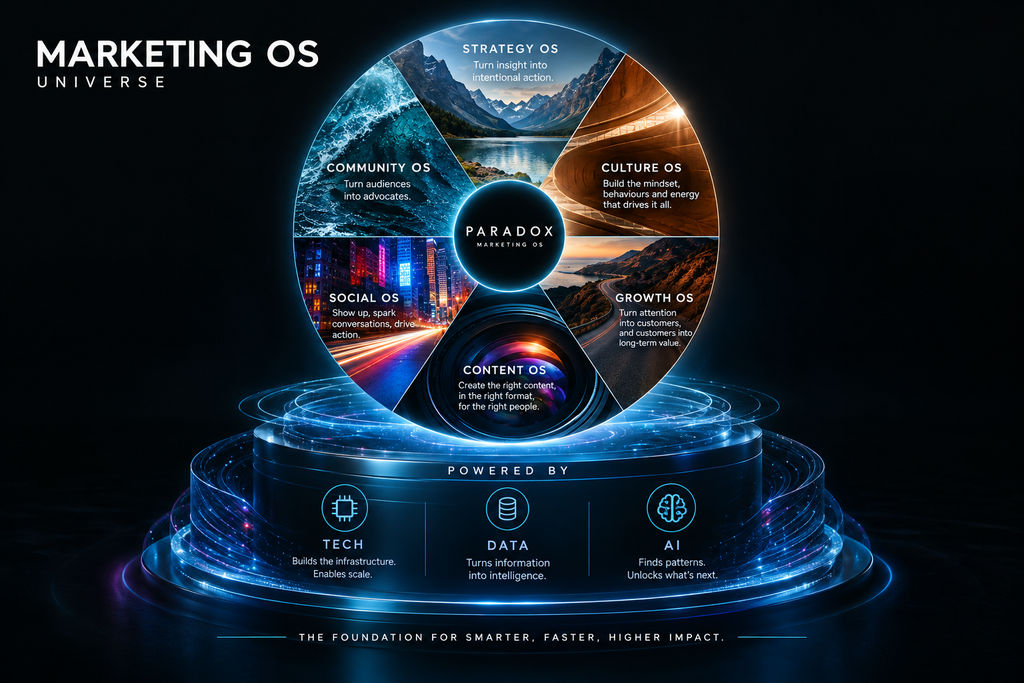
One operating system for marketing.
The PARADOX Marketing OS connects six marketing capabilities into one system:
Strategy → Culture → Growth → Content → Social → Community
They are not six separate services.
Each module informs the next. Each feeds information back into the system.
- Strategy identifies the business problem.
- Culture finds where the brand can matter.
- Content gives the idea something to say.
- Social gets it into the right environments.
- Growth turns attention into action.
- Community turns audiences into relationships.
Then the results feed back into strategy.
The system gets smarter as it works.
The six modules
01 — Strategy OS
Give marketing a job to do.
Strategy OS connects marketing to the business.
We define the commercial problem, establish the brand position and give every activity a clear role.
Includes:
- Business and marketing strategy
- Brand strategy
- Proposition and messaging
- Digital and media strategy
- Product and pricing strategy
- Distribution and promotion
- Revenue growth management
The question:
What business or marketing problem are we solving?
02 — Culture OS
Find the territory your brand can own.
Culture OS looks beyond trends to understand the people, behaviours, communities and cultural truths that matter to your brand.
The goal is to identify a cultural territory that is relevant, distinctive, credible and commercially useful.
Includes:
- Consumer and category culture
- Cultural territory mapping
- Competitor territories
- Cultural tensions
- Communities and behaviours
- Language and emerging movements
- Creator ecosystems
- Brand permission
The question:
What should this brand mean in culture?
03 — Growth OS
Turn marketing into a growth system.
Growth OS connects brand activity to acquisition, conversion, retention and revenue.
Performance does not operate separately from brand. It amplifies what the brand is doing.
Includes:
- Paid social
- Paid search
- SEO
- CRM
- Lifecycle marketing
- Conversion optimisation
- Growth experimentation
- Acquisition and retention
- Marketing technology
- Data activation
The question:
How do we acquire, convert, retain and grow?
04 — Content OS
Turn strategy into things people can actually see.
Content OS is the production engine.
We turn strategic and cultural territories into original, useful and platform-ready content.
Not an endless factory of disconnected posts.
A modular content system designed to create more value from every production investment.
Includes:
- Content strategy
- Concept and campaign development
- Creative direction
- Art direction
- Copywriting
- Scripting
- Photography
- Videography
- Editing
- Modular content production
The question:
What do we create to express the strategy and culture?
05 — Social OS
Make the idea work where people actually spend time.
Not all social media platforms are created the same.
Social OS starts with the cultural territory, then maps the platforms, audiences and behaviours that matter.
One idea may look completely different on TikTok, YouTube, Instagram or another platform.
Includes:
- Platform strategy
- Audience plan
- Platform-native content
- Creator ecosystems
- Organic and paid social
- Social search and discovery
- Community signals
- Social commerce
The question:
How does the culture travel through platforms?
06 — Community OS
Turn audiences into participants.
Community is more than replying to comments.
Community OS helps brands build relationships around shared interests, behaviours, experiences, identities and cultural territories.
The ambition is to move brands from simply advertising in culture to participating in it.
Includes:
- Community strategy
- Community building
- Events and experiences
- Partnerships
- Sponsorships
- Creator relationships
- Brand ambassadors
The question:
How do audiences become participants and relationships?
One team. One system. Less complexity.
PARADOX gives ambitious businesses access to the capability of a modern marketing department without having to build and coordinate one themselves.
Senior strategic thinking.
Creative and cultural capability.
Growth and performance.
Content production.
Social expertise.
Community building.
All connected through one Marketing OS.
You run the business. We run the marketing.