
Marketing departments have a peculiar habit of getting bigger without necessarily getting better.
More people. More agencies. More platforms. More meetings. More campaigns. More reports. And, somewhere in the middle of all that activity, the rather important question of whether any of it is actually moving the business forward.
It’s not an unusual situation. A brand team develops the strategy. A creative agency makes the ads. A media agency distributes them. A social team manages the platforms. An influencer agency handles creators. Someone else looks after customer data. And the marketing director spends a considerable amount of time trying to make sure everyone is pulling in roughly the same direction.
On paper, it looks like a well-resourced marketing operation. In practice, it can resemble a collection of businesses sharing the same budget.
The problem isn’t necessarily the people, the agencies or even the structure. It’s the assumption that marketing can be managed as a collection of independent functions when customers experience it as one brand.
That distinction matters more than most businesses realise.
The department was built for a different kind of marketing
The traditional marketing department makes sense when you consider how marketing used to work.
Brands had relatively few channels to manage. Television, radio, print and outdoor dominated media. Campaigns were planned months in advance, creative production followed a fairly predictable process, and success was often measured through reach, awareness and sales.
Specialisation made sense. You could have a brand manager, an advertising agency, a media buyer and a research partner, each with a clearly defined responsibility. The boundaries between their work were relatively easy to draw.
Then the boundaries started disappearing.
A customer might discover a product through a creator, research it on TikTok, compare prices on a retailer’s website, read reviews on Google and eventually buy it in a physical store. They might encounter the same brand through a friend, a WhatsApp group or a conversation at work.
None of these interactions happens in isolation. They influence one another, often in ways that a conventional campaign plan struggles to accommodate.
Yet many businesses still organise their marketing around the very boundaries that customers have stopped recognising.
Social sits in one team. Performance sits in another. Content has its own production process. Customer data lives somewhere else. Each function has its own objectives, timelines and reporting requirements.
The result is a growing distance between how marketing is organised and how it actually works.
More activity doesn’t necessarily mean more progress
There’s a temptation to solve marketing’s complexity by adding more resources.
If social isn’t performing, bring in a social agency. If content production is slow, appoint another production partner. If campaign results are disappointing, invest in better analytics. If the brand isn’t growing, hire another strategist.
Sometimes those are precisely the right decisions. Specialisation has real value, and there are situations where additional expertise is exactly what’s missing.
But adding another specialist to an already disconnected operation doesn’t necessarily make it more connected.
In fact, it can make coordination considerably harder.
Every additional partner introduces another relationship to manage, another set of deliverables to align and another interpretation of what success looks like. Without shared priorities and clear ownership, the business ends up spending more time coordinating marketing than improving it.
Consider a simple example.
A business invests in a campaign designed to build demand for a new product. The creative team develops compelling content, the media agency drives traffic and the social team generates engagement. Each function reports encouraging results.
But the product is difficult to find in stores. The website has outdated product information. Customer questions go unanswered. And the sales team has little visibility into what the campaign is generating.
The campaign may have performed exactly as each agency was briefed to perform. Yet the business has failed to connect marketing activity to the customer experience and, ultimately, the commercial opportunity.
No single function necessarily failed. The system did.
This is where the distinction between marketing activity and marketing performance becomes important. Activity can be measured within individual functions. Performance requires an understanding of how those functions work together and what they collectively deliver.
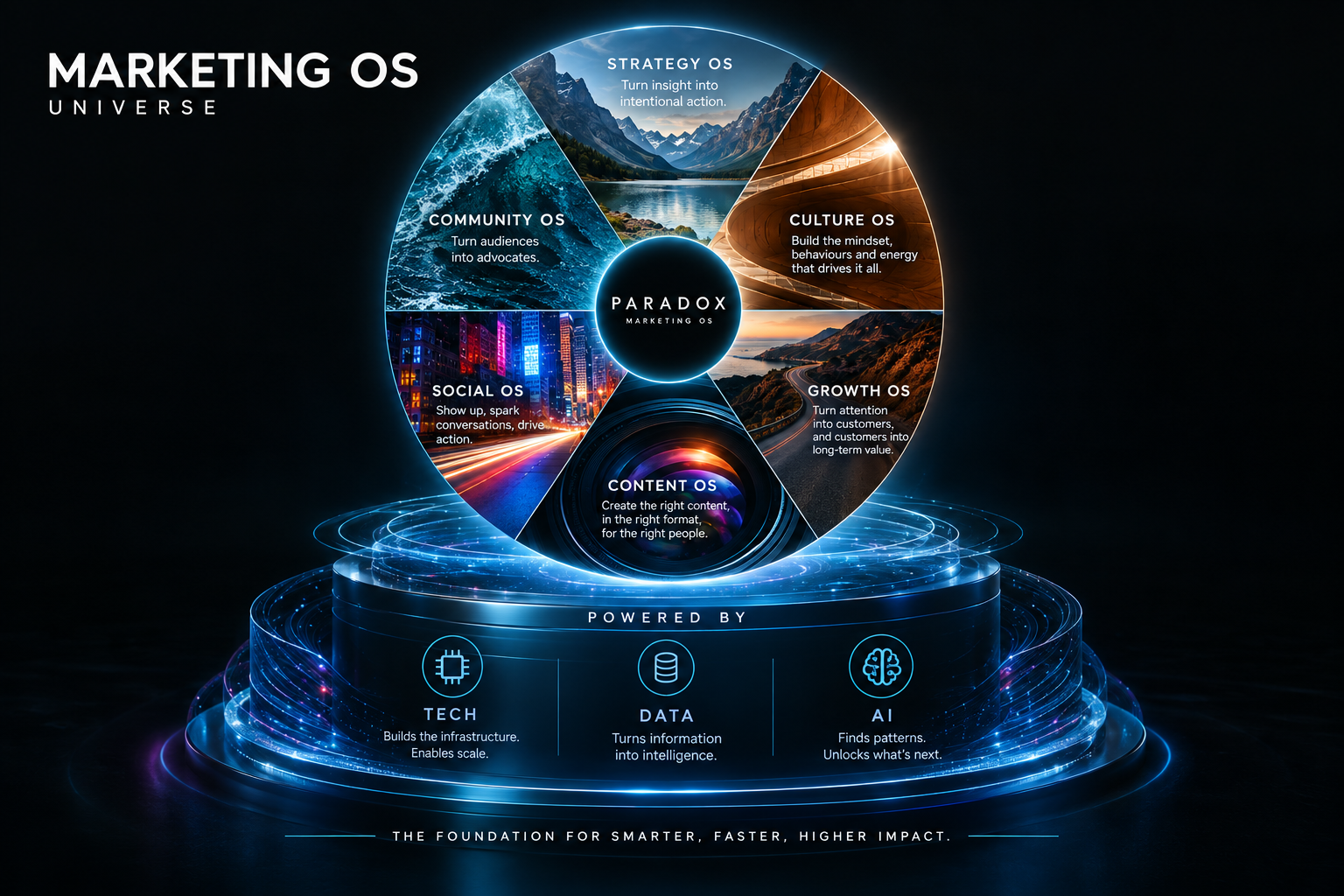
What if marketing worked more like an operating system?
An operating system doesn’t exist to make individual applications look good. It exists to make them work together.
It manages resources, establishes rules, connects processes and ensures that different components can perform their jobs without constantly getting in one another’s way.
Marketing could benefit from the same thinking.
Instead of treating strategy, creative, media, social and customer engagement as separate activities that need to be coordinated, businesses could organise them as interconnected capabilities, working towards shared commercial objectives.
That’s what it means to think of marketing as an operating system.
The idea is simple: Strategy determines where the business wants to go. Culture helps it understand the people and markets it serves. Growth connects marketing to commercial outcomes. Content gives the brand something worth saying. Social gets it into relevant conversations. Community builds relationships that extend beyond individual campaigns.

None of these capabilities is particularly revolutionary on its own. The opportunity lies in how they work together.
Consider what happens when a business understands a cultural shift in its market. That insight should influence its brand strategy, shape its creative direction, inform its content and guide where it invests its media budget. The response should then be measured against commercial objectives, with what the business learns informing its next move.
There’s no reason for that process to begin again every time a new campaign is commissioned.
When these capabilities share information, priorities and accountability, marketing can become more responsive without becoming more chaotic. Decisions have context. Creative work has direction. Performance has meaning beyond a dashboard.
And, perhaps most importantly, the business has a clearer view of how its marketing contributes to growth.
Integration is not the same as putting everyone in one room
There’s an important distinction worth making here. An operating system isn’t simply an integrated marketing department with a new name.
Putting brand managers, performance marketers, designers and social media specialists in the same office doesn’t automatically make their work connected. Neither does giving them access to the same project management software or asking everyone to attend the same weekly meeting.
Integration requires something more fundamental: shared responsibility for the outcome.
A content team shouldn’t be concerned only with how much content it produces. It should understand what the content is intended to achieve and how its performance informs future decisions.
A performance team shouldn’t optimise media spend in isolation. It should understand the brand, the audience and the commercial implications of the customers it acquires.
Likewise, strategy shouldn’t become a document that gets handed over and forgotten. It should actively inform the decisions being made across marketing.
This doesn’t mean everyone needs to do everything. Specialisation remains important. What changes is the relationship between specialists and the outcomes they’re collectively responsible for.
The distinction is between a collection of people completing their respective tasks and a group of specialists operating with a shared understanding of what the business is trying to achieve.
One produces deliverables. The other has the potential to produce progress.
Technology can connect the work. it can’t replace the thinking.
Technology has made it considerably easier to connect marketing activities. Data platforms can bring information together, automation can remove repetitive work, and artificial intelligence can accelerate research, analysis and content production.
But technology doesn’t automatically solve organisational problems.
A business can have sophisticated analytics and still make poor decisions. It can automate its content workflow and produce an extraordinary amount of material that nobody finds interesting. It can have a single dashboard containing every marketing metric imaginable and still struggle to explain what is driving growth.
Technology is useful when it supports a clear way of working. Without one, it can simply make existing inefficiencies faster.
The same applies to artificial intelligence. Its ability to reduce the cost and time involved in certain marketing activities is significant. But cheaper execution doesn’t eliminate the need for sound strategy, cultural understanding, creative judgement or commercial accountability.
In an operating system for marketing, technology should connect information, simplify processes and improve decision-making. It shouldn’t dictate the strategy or become a substitute for professional judgement.
The distinction is particularly important for growing businesses, where technology investments can quickly become expensive distractions if they aren’t tied to a genuine operational need.
The real shift is from managing activity to owning outcomes
Perhaps the most important implication of treating marketing as an operating system has very little to do with technology or organisational charts.
It’s accountability.
Traditional marketing structures often make it relatively easy to establish who is responsible for a deliverable but considerably harder to establish who is responsible for the outcome.
The agency delivered the campaign. The media team achieved its reach target. The social team met its publishing schedule. The content team produced everything on time.
But did the business acquire valuable customers? Did it improve demand? Did it strengthen its position in the market? Did marketing contribute to profitable growth?
These questions are harder to answer because their answers rarely sit neatly within a single function.
An operating-system approach shifts the conversation. Rather than measuring success exclusively through individual outputs, it encourages businesses to connect those outputs to shared objectives and take collective responsibility for what happens next.
That doesn’t mean every marketing outcome is entirely within marketing’s control. Pricing, product quality, distribution and customer service all influence commercial performance. A sound operating model recognises those dependencies rather than pretending marketing operates independently of the rest of the business.
It does, however, make it easier to identify where marketing is contributing, where it’s falling short and what needs to change.
For business leaders, that creates a much more useful conversation than another presentation full of campaign metrics.
A different way to think about marketing
None of this suggests that every business needs a complete organisational overhaul. Some departments already operate in highly connected ways. Others may simply need clearer priorities, better processes or more effective collaboration with their existing partners.
The operating-system concept isn’t a universal organisational blueprint. It’s a different way of thinking about what marketing is responsible for and how its capabilities should work together.
For a growing business, that might mean replacing several disconnected suppliers with a coordinated team. For a larger organisation, it might mean changing how existing departments share information, make decisions and measure performance.
The structure will differ. The underlying principle doesn’t have to.
Marketing should be organised around the work required to build demand, create relevance and grow the business, rather than around the historical boundaries of individual marketing disciplines.
And that brings us back to the department itself.
Departments aren’t inherently the problem. They provide structure, specialisation and accountability. But when the structure becomes more important than the work it’s supposed to enable, it’s worth questioning whether it’s still serving the business.
Marketing doesn’t need to become another department with a more fashionable name. It needs a way of working that reflects how brands, businesses and customers actually interact.
Perhaps the more useful question for business leaders isn’t how big their marketing department should be, or how many agencies they should appoint.
It’s whether all those people, platforms and activities are genuinely working towards the same outcome.
Leave a Reply