
There’s something interesting about the way we celebrate African brands when they arrive on a global stage.
We talk about breaking barriers, earning recognition and finally being taken seriously. We celebrate the invitation, the front row and the official calendar slot.
And we should.
But watching MaXhosa Africa make its Paris Fashion Week debut on 28 September 2026, I kept coming back to another question: why does recognition from elsewhere still feel like the final stamp of legitimacy?
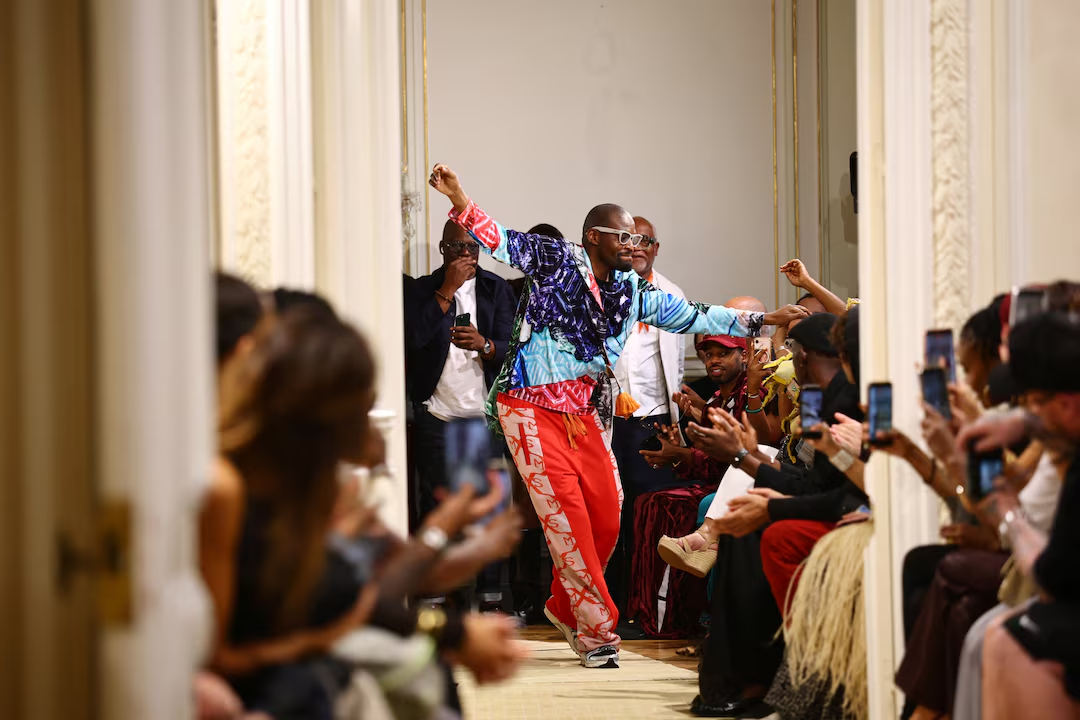
Founded by Laduma Ngxokolo, MaXhosa presented its Spring/Summer 2027 collection, Izihlwele Zivumile, at the residence of the South African ambassador to France. After 16 years of building the brand and five previous Paris presentations, this wasn’t MaXhosa’s first encounter with Paris. It was simply the first time Paris gave them a runway.
And perhaps that distinction is the more interesting story.
Because MaXhosa didn’t arrive looking like they had been waiting for permission to become a luxury house.
They arrived looking like they already knew what it was.
The world doesn’t get to decide what luxury looks like
Luxury fashion has historically been centred around a handful of cities, institutions and houses. Paris is obviously one of them.
The issue isn’t that Paris matters. It does. The issue is when its influence becomes the benchmark against which everyone else is measured.
African luxury brands often find themselves navigating an odd expectation: be distinctly African enough to be interesting, but familiar enough to be accepted by an industry whose definition of luxury has largely been shaped by European references.
MaXhosa has never really played that game.
Its identity isn’t an African print placed onto an otherwise conventional luxury proposition. The knitwear, patterns, colours, beadwork and cultural references aren’t there simply to make the clothes look different to an international audience.
They are the foundation of the brand.
That became particularly clear with Izihlwele Zivumile, which translates to “the ancestors have approved” or translated by the Fédération de la Haute Couture et de la Mode as “the ancestors have co-signed.”
There is something beautifully audacious about that title.
Not we hope Paris likes it.
The ancestors have already signed off.
The collection brought together 54 looks, including vibrant knitwear, geometric patterns, tailoring, beadwork and flowing silhouettes. One look incorporated the names of African countries, while other pieces engaged with African geography and history.
This wasn’t Africa being translated for Paris.
It was Africa arriving in Paris in its own language.
The culture was in the clothes, but also under their feet
What made the show particularly compelling was that the cultural storytelling didn’t stop at the clothing.
Grass mats were incorporated into the set and used as the surface of the runway. It is a detail that could easily be overlooked, but it changes how the collection is experienced.
The models weren’t simply wearing South African cultural references while walking through a neutral Parisian environment. The environment itself carried the reference.
The mats became the stage.
That meant the integration of South African culture wasn’t reduced to a pattern, colour or symbol on a garment. It shaped the physical space in which the collection existed.
That distinction matters because there is a difference between using culture as an aesthetic and allowing it to inform an entire creative world.
MaXhosa did the latter.
The same can be said of the collection’s use of symbolism. The ankh appeared in some of the pieces, bringing an ancient African symbol associated with life and eternal existence into a contemporary luxury context.
Then there were the striking one-eye sunglasses.
Visually, they immediately bring to mind the “all-seeing eye”, while the single-lens form can also recall the Cyclops of European mythology. Without an explicit explanation from MaXhosa, it would be too easy to confidently assign one meaning to the piece. And perhaps that ambiguity is part of what makes it interesting.
African fashion does not have to exist inside one neat definition of what “African” looks like. Its references can move across histories, cultures and visual languages while still being part of a distinctly African creative conversation.
Sjava wasn’t just the soundtrack
Then there was Sjava.
A musician performing at a fashion show isn’t exactly revolutionary. Fashion and music have been intertwined for decades.
But Sjava’s role felt more deliberate than simply providing the soundtrack.
He performed from the balcony, meaning his presence extended beyond the audience seated inside the runway space. People outside could see and hear him too.
More importantly, he wasn’t styled as though he had stepped into an entirely separate fashion world for the occasion.
Sjava is already known for incorporating traditional Zulu-inspired pieces and references to his heritage into his performances and personal style. For the MaXhosa show, elements of the brand were integrated into that existing visual language.
That made him feel like part of the runway rather than an artist brought in to decorate it.
There was a sense of continuity: Sjava remained Sjava, MaXhosa remained MaXhosa, and the two worlds met naturally.
That relationship is even more meaningful given Sjava’s longstanding connection to the brand. He has spoken about supporting MaXhosa from its early days, when he could only afford smaller pieces like its pins.
So seeing him perform as the brand reached one of its biggest international milestones felt less like a celebrity appearance and more like a full-circle moment.
He wasn’t just accompanying the clothes.
He was part of the story.
Culture isn’t a marketing angle
This is where conversations around African fashion can sometimes become too simplistic.
Whenever an African brand succeeds internationally, we immediately talk about representation.
Representation matters. But if we stop there, we reduce the achievement.
MaXhosa is not significant simply because it is South African. It is significant because it has spent 16 years developing a recognisable fashion language rooted in its own cultural foundations.
The collection’s references to African countries, geography, symbolism and heritage weren’t isolated marketing moments. They appeared across the clothing, accessories, music and set design.
Culture wasn’t an accessory to the brand.
It is the brand.
And that is where cultural specificity becomes powerful. Not when a brand says, “Look, we’re African,” but when you can remove the caption and still understand that the work comes from somewhere specific.
Paris is a platform, not the finish line
There is no question that securing an official runway slot in Paris is significant.
It brings visibility, industry access and the opportunity to engage with an international fashion audience in a way that previous static presentations could not.
But the milestone shouldn’t become the whole story.
A runway show can create attention. It can generate conversation and introduce a brand to new audiences.
What it cannot do by itself is guarantee long-term commercial success.
The harder questions begin after the applause.
Can MaXhosa turn this visibility into lasting customer relationships and international growth? Can they scale without losing the craftsmanship and cultural specificity that made the brand distinctive? Can they participate in the global luxury market without allowing that market to reshape the brand’s identity?
These questions aren’t criticisms of MaXhosa. They’re simply the realities of building any luxury business.
And African brands arguably face another layer of pressure because their individual success is often expected to represent an entire continent.
MaXhosa doesn’t need to carry African fashion on its back.
It needs to be allowed to build a great luxury business.
Africa doesn’t need permission to be luxury
Perhaps that is the bigger takeaway from the Paris debut.
Global relevance doesn’t have to mean cultural dilution.
There is a difference between making something accessible to an international audience and making it less culturally dense so that an international audience can understand it.
MaXhosa’s collection showed that a brand can enter one of the world’s most established fashion systems without pretending that its identity comes from that system.
It can bring its own references, its own visual language and its own history into the room.
And that is precisely what makes it interesting.
African fashion doesn’t need to prove that it can imitate the traditional luxury houses. It can contribute something else: fashion rooted in heritage, music, craft, spirituality, mythology, memory and contemporary African life.
That doesn’t make it less luxurious.
It makes it its own.
MaXhosa didn’t suddenly become a luxury brand when it walked onto the Paris runway. It was a luxury brand before the invitation.
Paris simply gave more people a reason to look.
And perhaps that’s the real significance of Izihlwele Zivumile.
The ancestors have already co-signed.
Now the rest of the world can catch up.
Leave a Reply